One of the things I have come to love about the Eastern Sierra is that tucked away in backyard gardens and little patches of dirt throughout the valley are crops that have their own rather remarkable histories.
Take the Chileno pepper, for example.
It has become such an integral part of the food culture of the Owens Valley. Generations of people have grown them, pickled them, shared them with their neighbors, and carefully saved their seeds for the following year. There are family traditions built around this little pepper.
And I suspect there are far more of these stories scattered throughout our valley than most of us realize.
Behind each of these crops are people who have spent years figuring out how to grow things in this rather peculiar landscape of ours. People who have experimented, selected their best plants, saved their seeds, and accumulated an incredible amount of knowledge about growing that specific crop in the Eastern Sierra.
Much of this knowledge has never been written down. The longer I farm here, the more interested I become in these little pieces of our agricultural history. I want to know what people have been growing in their gardens for the past forty or fifty years. Where they got their seeds. Why they kept growing a particular variety. What they learned along the way.
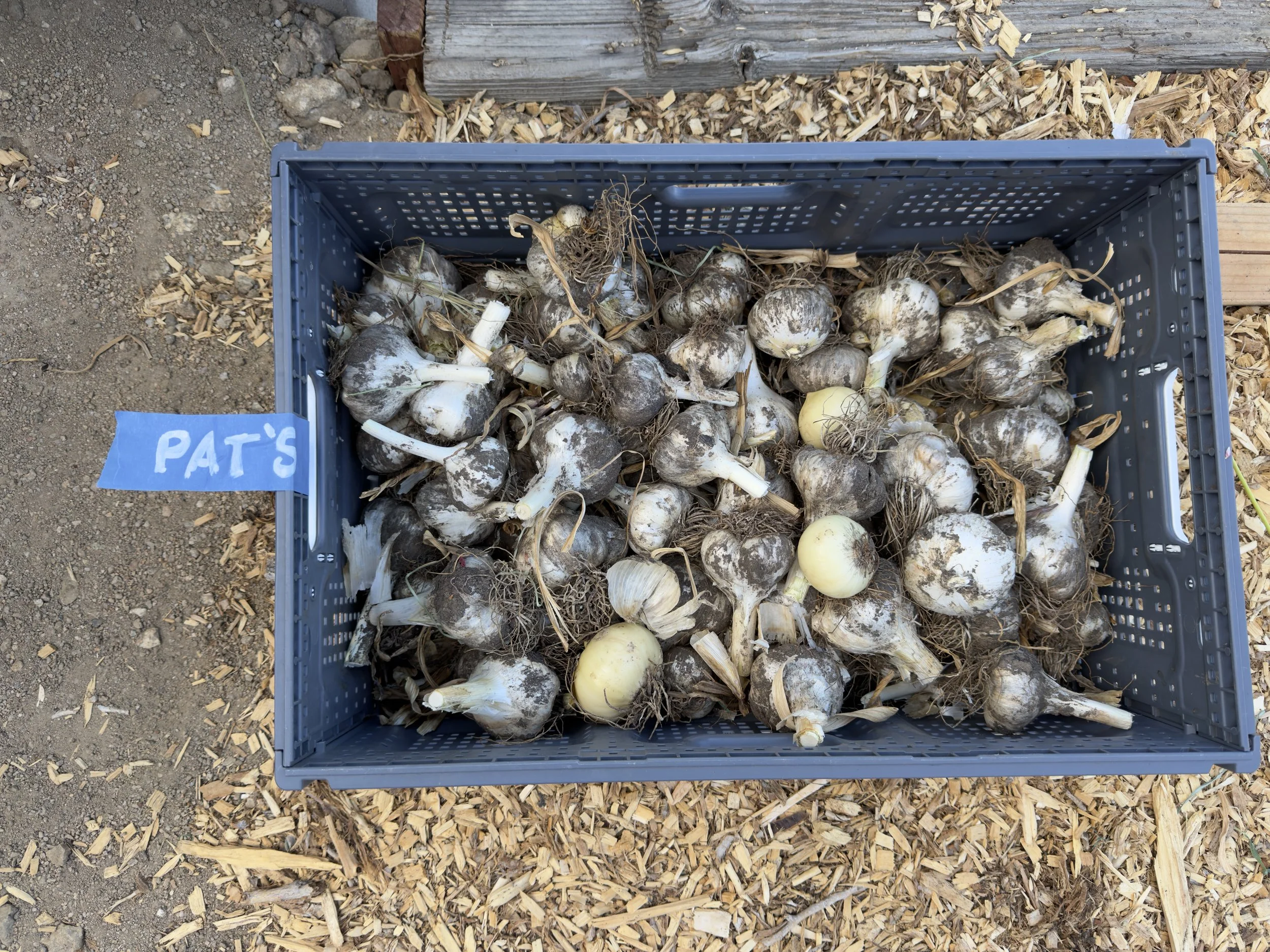
Pat’s Elephant Garlic
We lost Pat just over a year ago, and I was entrusted with the responsibility of carrying on his elephant garlic. So this year, alongside the hardneck garlic we traditionally grow here at Blue Heron Farm, we made room for a rather special new addition to our fields.
Of all the things we planted this fall, none felt quite as personal as those cloves of Pat’s garlic. It is a responsibility I don’t take lightly, and one that means a great deal to me. Because, in this particular instance, it’s not just about keeping a crop alive. It’s about carrying on a little piece of someone I loved.
Many of you knew Pat through his incredible 53 years of service to the Bishop Fire Department. I was fortunate enough to call him a friend. The kind of friend who always made time for coffee, (mostly) patiently entertained my endless questions, my emergency contact to know where I was going when I left town and when I was expected back, and whose response whenever I found yourself in a pickle was immediately, “I’m on my way.” He had the most endearing way of getting flustered, his cheeks turning bright red, and I have this one perfect little memory of him sitting on the kitchen counter at the firehouse after someone cracked a joke that still just melts my heart every time I think about it.
Now, truth be told, Pat was stubborn as all get-out, a rather tough nut to crack, and not exactly one for grand displays of affection. But if you wanted to understand how Pat showed his love for people, you needn't look much further than his garden.
He was known for sweet corn, zucchini (which he made into his famous zucchini bread), and, of course, his elephant garlic. And if you were lucky enough to be on the receiving end of something Pat had grown, you knew darn well how lucky you were. Sharing food from his garden was one of the ways Pat showed you he cared, without ever having to say so.
As someone who also shows their love through growing and sharing food, there is something about that part of Pat that resonates particularly deeply with me. I understand the time and care that goes into growing something with your own two hands, and the genuine joy that comes from giving it away to someone you care about.
I miss my friend. And it feels particularly important to me that we keep growing his garlic.
Preserving this valley’s agricultural heritage requires our active participation. For these crops to survive, someone has to save the seed. Someone has to prepare the soil. Someone has to make the decision, year after year, that this particular crop is worth growing again.
As we continue to build Blue Heron Farm, I would love for preserving some of that agricultural heritage to become a part of what we do here.
I don't simply want to grow food in the Eastern Sierra. I want to grow food that has a history here. I want to seek out some of these crops, learn their stories, make room for them in our fields, and get them back into the hands of our community.
And for those of you who have something with a bit of local history growing in your backyard, I would love to hear those stories.
As for Pat’s elephant garlic, I hope that twenty years from now, we are still growing it here at Blue Heron Farm. Better yet, I hope it is growing in dozens of gardens throughout the valley. I hope people are sharing it with their neighbors, saving a few bulbs for the following year, and telling the story of where it came from.
Though I am sure at some point there was a name with the variety, Pat didn’t know what it was called, it got handed down to him as well, I will always just call it Pat’s garlic.
Because in continuing to grow and share his garlic, I think we get to carry forward not only a little piece of our agricultural history, but also a little bit of the way Pat loved this community.
And that is a tradition well worth keeping alive.